Who Enforces the Rules: Authority, Inspectors, and Penalties🔗
Beginner
This article is in the Getting Licensed topic, after Across Borders. Covers Basic exam section B-001 (Regulations and Policies), topics B-001-001 and B-001-003.
Most amateurs never meet a radio inspector. The bands are largely self-policing: operators who hear a problem usually sort it out between themselves. But behind that courtesy is real law, with inspectors who can seize equipment, a Minister who can suspend a certificate, and fines that reach $50,000 for repeat violations.
Two ideas cover the machinery:
- Every amateur rule traces back to one Act. The Radiocommunication Act creates the offences and gives two bodies the power to fill in the details: Cabinet makes the Regulations, and the Minister sets the standards and runs the system through Innovation, Science and Economic Development Canada (ISED).
- Enforcement has limits written into it. An inspector can't walk into your home without consent or a warrant, and a certificate can't be suspended without notice. Knowing those limits is part of knowing the rules.
The sources are the Radiocommunication Act and the Radiocommunication Regulations, both current to September 21, 2026.
Idea One: One Act, Two Branches🔗
The Act is the root. It says who may operate radio equipment and what's forbidden, and it sets the penalties. Then it hands out the power to write the details.
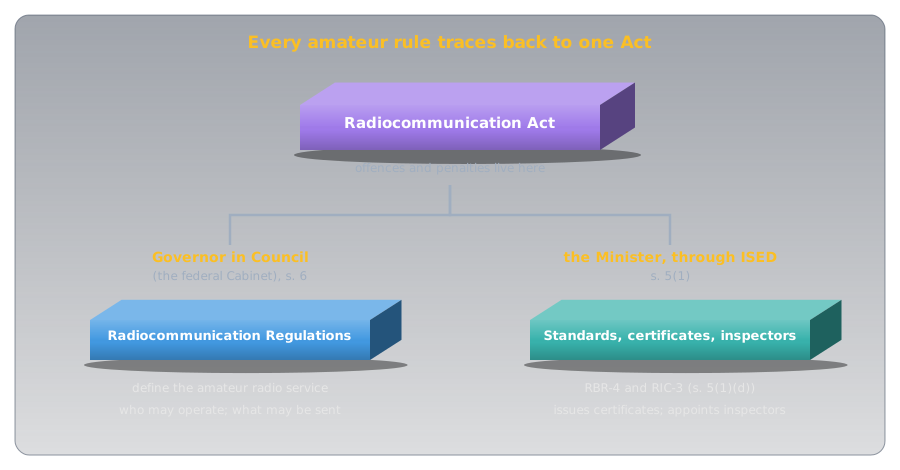
- The Regulations come from Cabinet. Section 6(1) of the Act: "The Governor in Council may make regulations." The Radiocommunication Regulations are those regulations, and they're where the amateur radio service is defined: radio used "for the purpose of self-training, intercommunication or technical investigation by individuals who are interested in radio technique solely with a personal aim and without pecuniary interest."
- The standards come from the Minister. Section 5(1)(d) lets the Minister "establish technical requirements and technical standards in relation to" radio apparatus. RBR-4, the standard behind What You May Transmit, is one of them, and section 45 of the Regulations requires amateurs to follow it.
- ISED runs the system. The Act's "Minister" is the Minister of Industry, today titled the Minister of Innovation, Science and Industry, whose department, ISED, administers the Act. Under section 5(1) the Minister issues radio operator certificates, appoints inspectors, and may order a station causing harmful interference to "cease or modify" its operation.
- The offences stay in the Act. Neither the Regulations nor RBR-4 sets penalties for themselves. When the exam asks which document states the offences and penalties, the answer is the Act.
Idea Two: Enforcement With Limits🔗
ISED has four tools: inspection, suspension, administrative penalties, and prosecution. Each one comes with conditions.
Radio Inspectors🔗
The Minister appoints inspectors under section 5(1)(j), and section 8 sets out what they may do.
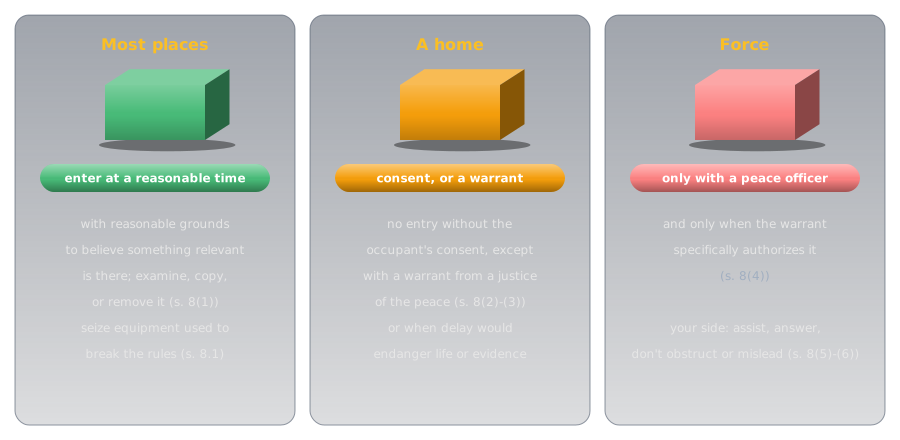
- Entry. An inspector may "enter, at any reasonable time, any place in which they believe on reasonable grounds there is any document, information or thing relevant" to checking compliance, and examine, copy, or remove it (section 8(1)). They carry a certificate of appointment and must show it on request.
- Homes are different. Section 8(2): an inspector "may not enter that dwelling-house without the consent of the occupant," except with a warrant or in "exigent circumstances," where the delay of getting one "would result in danger to human life or safety or the loss or destruction of evidence."
- Warrants. If entry is refused and is necessary to check compliance, a justice of the peace may issue a warrant (section 8(3)). Even then, section 8(4) says the inspector "shall not use force unless the inspector is accompanied by a peace officer and the use of force is specifically authorized in the warrant."
- Seizure. Section 8.1 lets an inspector seize radio apparatus they have reasonable grounds to believe "is or was used to contravene" the Act or Regulations.
- Your duties. The person in charge of the place must give "all reasonable assistance" and any information the inspector reasonably requests (section 8(5)), and must not obstruct the inspector or knowingly make "a false or misleading statement" (section 8(6)). Separately, section 38 of the Regulations gives you 48 hours to show your certificate, or a copy, when an inspector asks, as Getting Your Certificate covers.
Suspension and Revocation🔗
A certificate is valid for life, but section 5(2) of the Act lets the Minister suspend or revoke it in three situations.
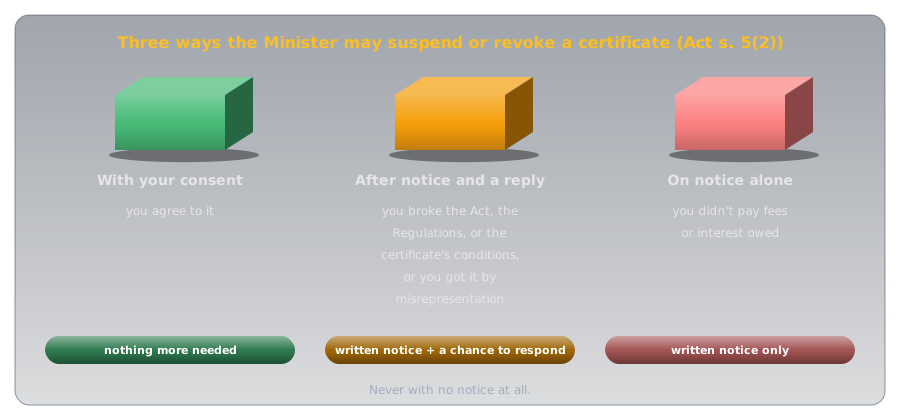
- With your consent.
- After written notice and "a reasonable opportunity to make representations", where the Minister is satisfied you've contravened the Act, the Regulations, or the certificate's terms, or that you obtained it "through misrepresentation."
- On written notice alone, without the chance to respond, where you've "failed to comply with a request to pay fees or interest due."
There's no route with no notice at all.
Two Routes to a Penalty🔗
The Act has two separate penalty systems.
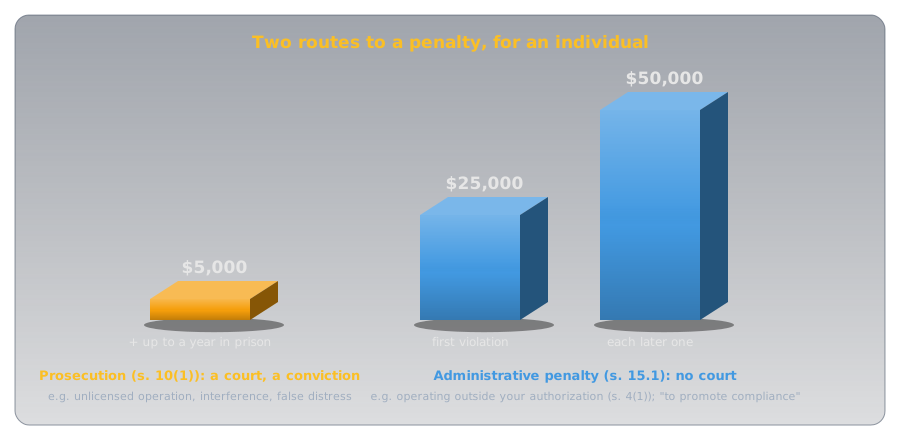
- Prosecution. Section 10(1) makes several acts offences "punishable on summary conviction": operating without an authorization (section 4), a false distress signal (section 9(1)(a)), interfering "without lawful excuse" (section 9(1)(b)), ignoring a Minister's interference order, or breaking a regulation that has no penalty of its own. An individual faces "a fine not exceeding five thousand dollars or … imprisonment for a term not exceeding one year, or … both." Section 10(2) adds a fine of up to $5,000 for obstructing or misleading an inspector.
- Administrative monetary penalties. Section 15.1 makes a contravention of section 4(1), among others, a violation: an individual is liable to a penalty "not exceeding $25,000 and, for a subsequent contravention, a penalty not exceeding $50,000." No court is involved; ISED issues a notice of violation. Section 15.11(2) says the purpose "is to promote compliance with this Act and not to punish."
Section 4(1) is the one most relevant to an amateur: no one may operate radio apparatus "except under and in accordance with a radio authorization." Your certificate is that authorization, and it covers the amateur bands only. Transmitting outside them is operating outside your authorization, and the person responsible is the control operator.
False Signals🔗
The Act's term is a "false or fraudulent distress signal, message, call or radiogram of any kind" (section 9(1)(a)). A fake "MAYDAY" is the obvious case, but the exam's broader rule is simply that transmitting false information is never permitted: not as a joke, not to hide your identity, and not to exaggerate an emergency so help comes faster.
Common Misconceptions🔗
- "An inspector can come into my house any time." Not without your consent, a warrant, or a genuine emergency (section 8(2)).
- "ISED can cancel my certificate without telling me." Every route in section 5(2) involves your consent or written notice.
- "Fines are in the Regulations." The offences and penalties are in the Act.
- "A fine needs a court case." Administrative monetary penalties don't (section 15.1).
Practice🔗
1. Where the Penalties Are
Which document states the offences and penalties relating to radiocommunications?
Solution
The Radiocommunication Act (sections 9, 10, and 15.1). The Regulations define the amateur service; RBR-4 sets technical standards.
2. A Knock at the Door
A radio inspector asks to enter your home to look at your station, and you decline. What can the inspector do?
Solution
Apply to a justice of the peace for a warrant (section 8(3)). Without consent, a warrant, or exigent circumstances, they may not enter.
3. Using Force
When may an inspector executing a warrant use force?
Solution
Only when accompanied by a peace officer, and only if the warrant specifically authorizes force (section 8(4)).
4. Suspension
The Minister believes you've broken the Regulations. Can your certificate be suspended immediately, without notice?
Solution
No. For a contravention, the Minister must give written notice and a reasonable opportunity to make representations (section 5(2)(b)).
5. Off the Band
You transmit just outside an amateur band for a quick test at low power. Is that allowed?
Solution
No. It's operating outside your authorization (section 4(1)); there's no exception for low power or short tests, and the control operator is responsible.
6. The Maximum
What's the maximum penalty for an individual convicted of interfering with a radiocommunication without lawful excuse?
Solution
A fine of up to $5,000, up to a year in prison, or both (section 10(1)).
Quick Recap🔗
-
One Act at the root
The Radiocommunication Act creates the offences and penalties and delegates the details.
-
Two branches
Cabinet makes the Regulations, which define the amateur service. The Minister sets standards like RBR-4 and runs the system through ISED.
-
Inspectors
May enter most places at a reasonable time; a home only with consent, a warrant, or exigent circumstances. Force only with a peace officer and a warrant authorizing it.
-
Your duties
Assist, answer reasonable requests, don't obstruct or mislead. Show your certificate within 48 hours.
-
Suspension
With consent; after notice and a chance to respond; or on notice alone for unpaid fees. Never with no notice.
-
Penalties
Prosecution: up to $5,000 and a year. Administrative: up to $25,000, then $50,000.
-
On the exam
The Act authorizes the Regulations and the standards (RBR-4) and states the offences and penalties. ISED administers the Act. The Regulations define the amateur radio service. False distress and interference: up to $5,000, one year, or both. A fake MAYDAY is a "false or fraudulent" message. Transmitting off the amateur bands is prohibited and the control operator can be penalized. False information is never permitted. No suspension without notice. No home entry without consent or a warrant.
What's Next🔗
The most common reason an amateur deals with ISED isn't an inspection; it's an antenna. Antennas and Neighbours covers putting one up, keeping RF exposure within Safety Code 6, and settling interference complaints.
Further Reading🔗
Regulations
- Radiocommunication Act — sections 4 and 5 (authorization and the Minister's powers), 6 (regulations), 8 and 8.1 (inspectors and seizure), 9 and 10 (prohibitions and offences), and 15.1 (administrative monetary penalties)
- Radiocommunication Regulations — section 2 (the amateur radio service defined), 38 (showing your authorization), and 45 (RBR-4)
Related Articles
- What You May Say: Content, Control, and Emergencies — the prohibitions these penalties enforce
- Getting Your Amateur Radio Certificate in Canada — the authorization at the centre of it all
- The Amateur's Code — the self-policing that keeps enforcement rare