What You May Say: Content, Control, and Emergencies🔗
Beginner
This article is in the Getting Licensed topic, after What You May Transmit. Covers Basic exam section B-001 (Regulations and Policies), topics B-001-005 to B-001-012.
A Canadian amateur may talk to someone on another continent about antennas, the weather, or the dog, for hours, at no cost. The same operator may not play a song, sell a car, take a dollar for passing a message, or speak in a code only their friend understands. And in a disaster, when phone lines are down, the same radio may carry messages for the Red Cross, but only to other amateur stations.
Those rules aren't arbitrary. Two ideas explain all of them:
- Amateur radio is open talk between amateurs, for its own sake. The Regulations define the service as being for "self-training, intercommunication or technical investigation" by people interested in radio "solely with a personal aim and without pecuniary interest." Everything that isn't open, personal, and unpaid falls outside it.
- Someone qualified is always responsible. Every transmission has a certificate holder in control of it, and the law holds that person, and the station's owner, to account.
The sources are the Radiocommunication Act and the Radiocommunication Regulations, both current to September 21, 2026, and RBR-4 (Issue 3, July 2022).
Idea One: Open Talk Between Amateurs🔗
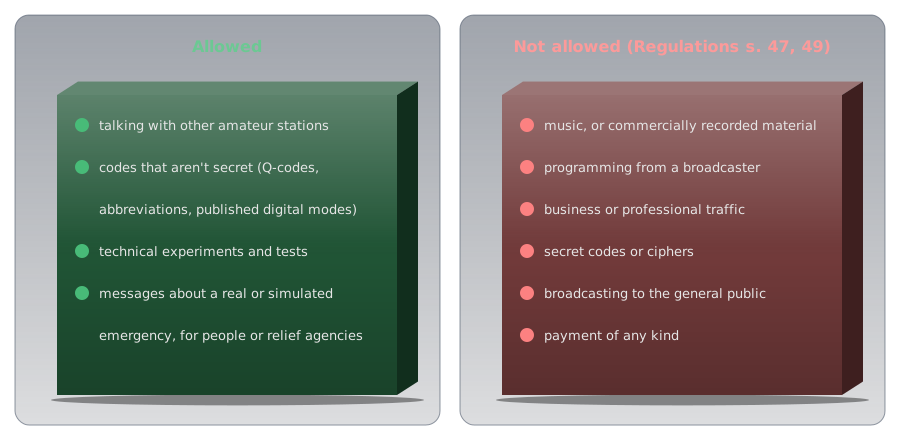
Section 47 of the Regulations sets out what an amateur station may do, and it's short enough to quote whole:
A person who operates radio apparatus in the amateur radio service may only (a) communicate with a radio station that operates in the amateur radio service; (b) use a code or cipher that is not secret; and (c) be engaged in communication that does not include the transmission of (i) music, (ii) commercially recorded material, (iii) programming that originates from a broadcasting undertaking, or (iv) radiocommunications in support of industrial, business or professional activities.
Each part has a reason:
- Only other amateur stations. Amateurs talk to amateurs; the police, ships, and aircraft have services of their own. Transmitting to the general public is broadcasting, which is a different, separately licensed service. One-way transmissions inside the amateur service, like a beacon that sends its call sign so others can test reception, are a different matter.
- No secret codes. Anyone listening must be able to understand what's sent, which is what keeps the bands self-policing. Codes that aren't secret are fine: Q-codes like QTH ("my location is"), standard abbreviations, and digital modes whose encoding is published.
- No music, recordings, or broadcast programming. Those are what broadcasting is for. The rule includes accidents: a radio playing in the background of your shack can be picked up by your microphone, so turn it down before you transmit.
- No business. Not a sale, not an appointment for your dental office, not a club's business planning. Communication "in support of industrial, business or professional activities" is out, every time.
Section 49 adds money: an amateur must operate "without demanding or accepting remuneration in any form in respect of a radiocommunication that the person transmits or receives." No payment for passing a message, no tips, no favours in kind.
Equipment Stays in Its Service🔗
The same openness applies to the equipment. ISED's frequently asked questions are direct: "amateur radio equipment may only be used to transmit on frequencies allocated for use by the Amateur Radio Service." Many amateur handhelds can be programmed for business or public-safety channels, but an amateur certificate doesn't authorize transmitting there; the FAQ notes that other services "may require additional certification and/or licensing." For the same reason, an amateur may not add an amplifier to a licence-exempt device, such as a family radio, to boost its range.
Idea Two: Someone Qualified Is Always Responsible🔗
Every transmission from an amateur station has a qualified person answerable for it.
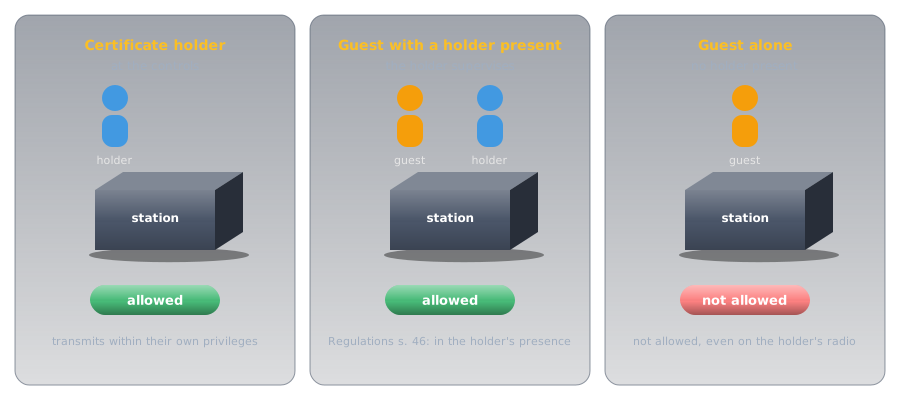
- Guests may operate, under supervision. Section 46 lets anyone "participate in the operation of radio apparatus in the amateur radio service under the supervision and in the presence of" a certificate holder. Without a holder present, a guest, including a family member, may not transmit, even on a holder's radio.
- The person in control sets the limits. Section 46 also says a holder who lets others operate does so "subject to compliance with the terms and conditions of that holder's certificate." So the privileges in force are always those of the qualified person in control, whatever equipment they're using.
- Owner and operator share responsibility. The question bank calls the qualified person a control operator, who must be at the station's control point whenever it transmits. If you operate someone else's station, you and the owner are both responsible for what it sends.
Working on Other People's Radios🔗
Section 39 of the Regulations lets a person "install, place in operation, modify, repair, maintain or permit the operation of radio apparatus on behalf of another person" only where that other person holds the licence the apparatus needs. Amateurs don't hold station licences, so the section's wording doesn't map exactly; the question bank applies the same rule to certificates. You may install, repair, or place in service an amateur station for someone else only if both of you hold an Amateur Radio Operator Certificate. That includes reprogramming a land-mobile radio for a friend's 2 m use: only if they're certified.
What Needs Advanced🔗
Some installations are reserved for the Advanced Qualification. Section 44 of the Regulations requires it to "install or operate a transmitter or a radio frequency amplifier that is not commercially manufactured," or to install a repeater that retransmits within the same band, or a club station. RIC-3 adds remote control of a station. According to the question bank, a Basic holder may still assemble commercially available transmitter kits of professional design, and operate cross-band repeaters.
Sharing the Bands: Interference🔗
Shared frequencies only work if nobody spoils them on purpose. Section 9(1)(b) of the Act says no person shall, "without lawful excuse, interfere with or obstruct any radiocommunication." The Act defines harmful interference as an adverse effect that "endangers the use or functioning of a safety-related radiocommunication system," or "significantly degrades or obstructs, or repeatedly interrupts" the use of radio equipment.
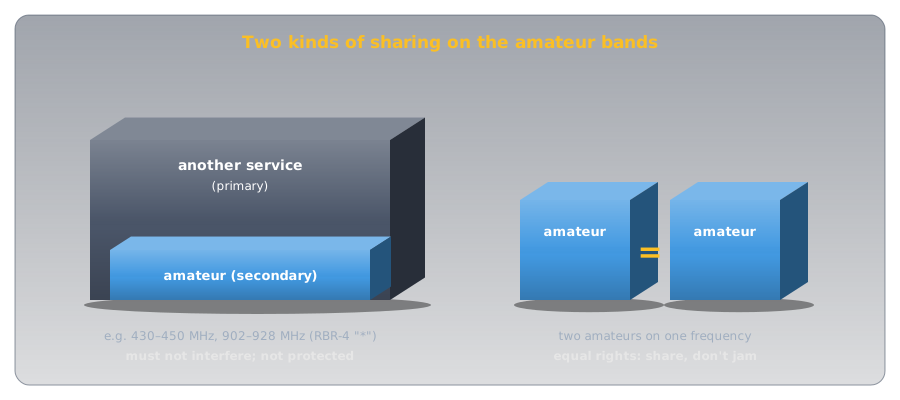
- With other services: RBR-4 section 8 says amateur transmissions shall not interfere with stations in another service "nor be protected from interference" caused by them, in the bands Schedule I marks with an asterisk. Among the bands a Basic holder uses most, 430–450 MHz (70 cm) and 902–928 MHz (33 cm) are marked this way. Being a secondary user means you may use the band only if you don't interfere with the primary user.
- Between amateurs: no one owns a frequency. Section 40 of the Regulations says an authorization "does not confer a monopoly on the use of the frequency or frequencies." Two amateurs who want the same one have equal rights to it, and deliberately interfering with another amateur's contact is never acceptable. Test transmissions are fine when they won't interfere with anyone.
- What ISED can do: where the Minister determines a station is causing harmful interference, the Act, section 5(1)(l), lets the Minister order its operation to "cease or modify." The bank also notes that the 902–928 MHz band can be heavily occupied by licence-exempt devices.
Emergencies🔗
Emergencies are where amateur radio is most useful, and the rules bend in exactly two places.
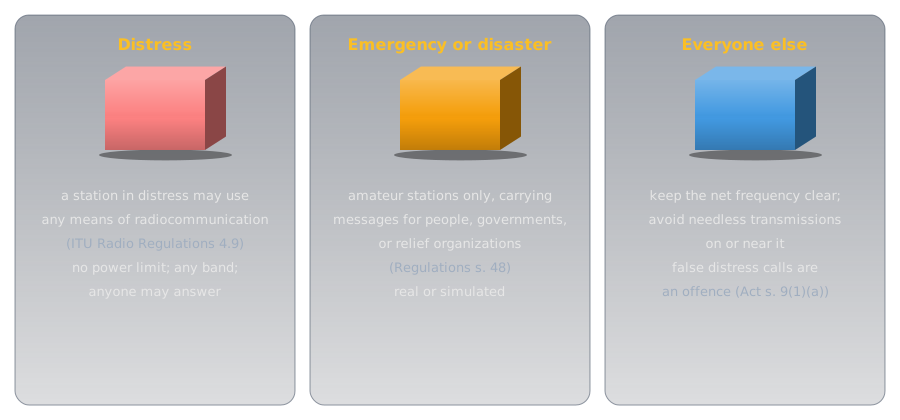
- Distress: a life in immediate danger. The international rule all the Canadian rules sit under, International Telecommunication Union (ITU) Radio Regulations No. 4.9, says nothing in them "prevents the use by a station in distress, or by a station providing assistance to it, of any means of radiocommunication at its disposal to attract attention, make known the condition and location of the station in distress, and obtain or provide assistance." So an amateur in distress may use any means, with no power limit, and an amateur who hears an unanswered distress call may answer it even on a band outside their privileges.
- Emergency or disaster relief. Section 48 of the Regulations: "In a real or simulated emergency, a person operating radio apparatus in the amateur radio service may only communicate with a radio station that is in the amateur radio service in order to transmit a message that relates to the real or simulated emergency on behalf of a person, government or relief organization." That opens amateur radio to messages for agencies, in emergencies and in practice exercises, when normal systems are overloaded, damaged, or disrupted. It does not open frequencies outside the amateur bands: relief traffic stays in the amateur service.
- Everyone else. Operators not involved in a relief net should keep off its frequency and avoid needless transmissions near it.
- The opposite crime. Section 9(1)(a) of the Act makes it an offence to "knowingly send, transmit or cause to be sent or transmitted any false or fraudulent distress signal."
Privacy and Penalties🔗
Radio is easy to overhear, so the law controls what you may do with what you hear. Section 9(2) of the Act: "no person shall intercept and make use of, or intercept and divulge, any radiocommunication, except as permitted by the originator of the communication or the person intended by the originator of the communication to receive it." Broadcasting is exempt (section 9(3)), and section 54 of the Regulations allows exceptions for protecting property or preventing serious harm, for evidence in court, and for law enforcement. Repeating a non-broadcast radio conversation to answer a reporter's questions is none of these, and is an offence.
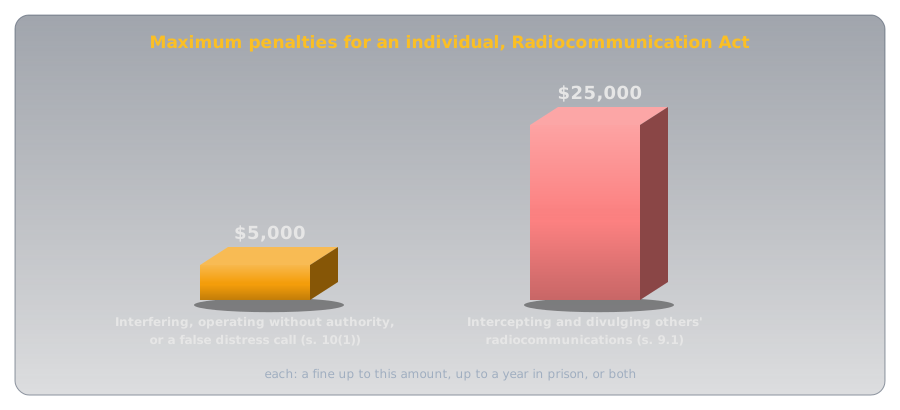
The Act puts numbers on these. Section 10(1): operating without authority (section 4), a false distress call, or interfering without lawful excuse can bring a fine of up to $5,000, up to a year in prison, or both. Section 9.1: intercepting and divulging others' radiocommunications can bring up to $25,000, up to a year in prison, or both.
On the exam: divulging amateur traffic
The question bank's answer is that radiocommunications may be divulged if they were "transmitted by an amateur radio station." I couldn't find that exception written in the Act or in section 54 of the Regulations; the closest reasoning is that amateur traffic can't be secret (section 47) and is meant for any amateur to hear. Learn the bank's answer, and treat everyone else's radio traffic as private.
Common Misconceptions🔗
- "A small donation for passing a message is fine." No remuneration "in any form" (section 49).
- "In a disaster, anything goes." Distress is an exception; disaster relief isn't. Relief traffic stays on amateur frequencies, between amateur stations.
- "My radio can transmit on the business band, so I can use it there." The certificate covers the amateur bands only.
- "Anyone in my house can use my station." Only with you, or another certificate holder, present and supervising.
Practice🔗
1. The Car for Sale
During a weekly club net, a member offers a used car for sale. Is that allowed?
Solution
No. Section 47 of the Regulations bars communications "in support of industrial, business or professional activities," and the Regulations define the service as being without pecuniary interest. Selling a car is business.
2. The Family Radio
Your teenager, who has no certificate, wants to call a friend on your 2 m handheld while you're out. Allowed?
Solution
No. Someone without a certificate may operate only "under the supervision and in the presence of" a certificate holder (section 46). With you present and supervising, they could.
3. A Published Mode
You've invented a new digital mode. When may you use it on the amateur bands?
Solution
Once its encoding is published, so it isn't secret. Section 47 allows only codes and ciphers "that are not secret."
4. Distress on HF
You hold Basic only. On a receiver you hear an unanswered distress call on 7.150 MHz. May you answer?
Solution
Yes. A station providing assistance to a station in distress may use any means of radiocommunication at its disposal (ITU Radio Regulations No. 4.9), even outside your normal privileges.
5. Disaster Relief
After a storm, a relief agency asks you to relay messages on a business-band frequency because their radios use it. Allowed?
Solution
No. Section 48 permits emergency messages for relief organizations, but only between stations in the amateur radio service. Frequencies outside the amateur bands stay off limits.
6. Secondary User
On 432 MHz your signal interferes with a station in another service. What does RBR-4 require?
Solution
Stop causing the interference. 430–450 MHz is marked in Schedule I as a band where amateurs "shall not cause interference" to other services and aren't protected from them (section 8).
Quick Recap🔗
-
Amateurs talk to amateurs
Only other amateur stations. No broadcasting to the public; beacons are fine.
-
Nothing secret, nothing for sale
No secret codes. No music, recordings, broadcast programming, or business. No payment of any kind.
-
Equipment stays in its service
Amateur radios transmit only on amateur bands. No amplifiers on licence-exempt devices.
-
A qualified person in control
Guests operate only with a holder present. The person in control sets the privileges; owner and operator share responsibility.
-
Working for others
Install or repair someone's amateur station only if they hold a certificate.
-
Sharing
Secondary users mustn't interfere and aren't protected. Between amateurs, equal rights; never interfere deliberately.
-
Emergencies
Distress: any means. Disaster relief: amateur stations only, for people, governments, and relief agencies.
-
On the exam
Install or repair for others only if both hold certificates; business never permitted; secret codes never; Q-codes fine; Advanced for same-band repeaters, club stations, homebrew transmitters and remote control; control operator at the control point while transmitting; harmful interference defined; secondary users on 430–450 and 902–928 MHz; no payment for messages; divulging non-broadcast traffic to the media is an offence.
What's Next🔗
These rules cover a station in Canada talking to other Canadians. Across Borders takes them international: the treaty above Canadian law, third-party traffic, visitors to Canada, and what your certificate allows when you travel.
Further Reading🔗
Regulations
- Radiocommunication Regulations — sections 39 and 40, and 42 to 49 (who may operate, what may be sent, emergencies, remuneration) and 54 (privacy exceptions)
- Radiocommunication Act — the definition of harmful interference, sections 9 and 9.1 (prohibitions and privacy), and 10 (penalties)
- RBR-4 — section 8 and Schedule I's shared-band markings
- ISED: Amateur Radio Frequently Asked Questions — equipment outside the amateur bands, and repeaters
- ITU Radio Regulations, 2024 Edition (PDF) — the international treaty, including No. 4.9 on distress
Related Articles
- What You May Transmit: Bands, Power, and Identification — the technical envelope of a legal transmission
- Getting Your Amateur Radio Certificate in Canada — the qualifications these rules refer to
- The Amateur's Code — the codes of conduct behind the rules